Touch as the Language of the Body
Long before a couple finds the right words for what they feel, their hands already know. A slow hand on a tired shoulder at the end of a long week, fingers tracing the back of a neck while the world goes quiet — these gestures are not small things. They are, in the language of John Paul II’s Theology of the Body, a vocabulary.
In his Wednesday Audiences, the late Pope described the body itself as a sign — a visible expression of an invisible reality. Spouses, he wrote, speak a “language of the body” through their physical presence to each other, a language that either proclaims the truth of self-gift or contradicts it. That framing — developed in full in his Theology of the Body — changes everything about how we think about physical touch in marriage. An unhurried caress is not a luxury squeezed in between responsibilities. It is a sentence in the ongoing conversation that is your marriage — a sentence that says, simply and profoundly, you are a gift to me.
That is why we take the question of a massage oil seriously at Vitae Sacra. Because if intentional, attentive touch between spouses is itself a kind of prayer — an embodied act of gratitude for the person God gave you — then what you choose to put on your skin during that time deserves the same thoughtfulness you bring to everything else in your marriage.
Why “Organic” Matters for Fertility-Aware Couples
The beauty and personal-care industry operates under remarkably loose labeling standards. The word “natural” on a bottle is essentially decorative — it carries no regulatory weight. More concerning, the category of “fragrance” on an ingredient label can legally conceal dozens of synthetic compounds, including some that research suggests may interfere with the endocrine system. Since skin absorbs what is applied to it — particularly in sensitive areas — this is not a theoretical concern for couples actively practicing Natural Family Planning or navigating fertility challenges. Couples in an active TTC season will find our review of natural fertility support supplements a useful companion resource for supporting the whole body during that season.
Endocrine-disrupting compounds found in some conventional massage products have been the subject of ongoing study precisely because of their potential to mimic or block hormones. For a couple whose fertile awareness depends on the body’s natural hormonal rhythms functioning clearly, introducing synthetic disruptors through something as intimate as a massage oil is worth avoiding — even if the risk isn’t definitively quantified.
Certified organic oils sidestep this concern almost entirely. When a product carries legitimate USDA Organic certification or is formulated from botanically certified ingredients, the ingredient list is short, readable, and free of the synthetic fragrance loopholes that make conventional products murky. You know what you are putting on the body — the same body your spouse has entrusted to your care.
There is also something fittingly sacramental about it. The body, as TOB insists, is a gift — given first by the Creator, then given again in the marital embrace. Caring for that gift with clean, earth-derived ingredients is a small but real act of reverence.
Our Curated Picks: What We Recommend and Why
We evaluated organic massage oils against four practical criteria: ingredient transparency, skin feel and absorption rate, scent profile (or lack thereof), and suitability for fertility-aware couples. Here is what we found genuinely worth recommending.
Foria Intimacy Organic Massage Oil
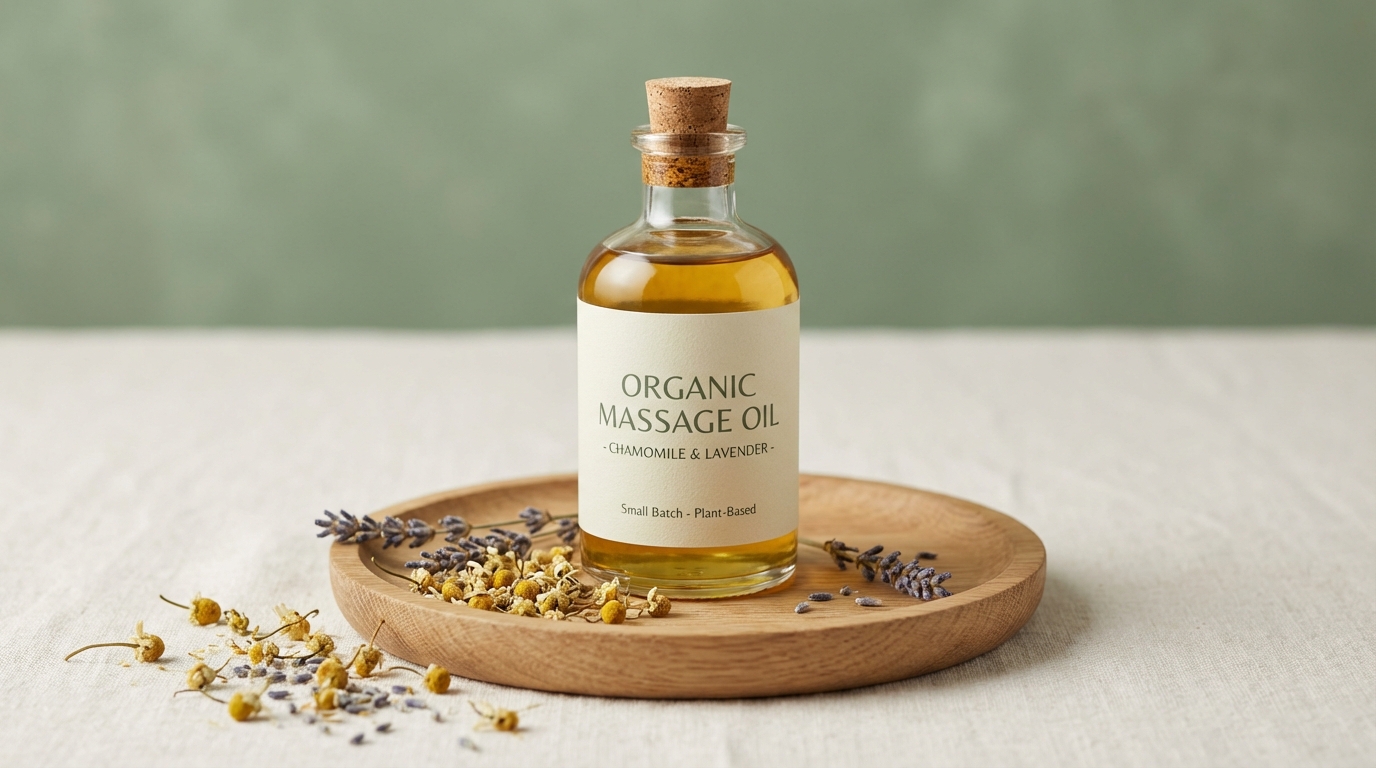
Foria has built a reputation in the wellness space for taking ingredient integrity seriously, and their massage oil reflects that. The base is organic fractionated coconut oil — lightweight, skin-compatible, and free of the heavy residue that makes some massage oils feel more like cooking than caring. The formula is certified organic and fragrance-free in its unscented variant, which we prefer for couples who are sensitive or who simply want the experience to be about presence rather than aromatherapy.
Texture-wise, it absorbs well without disappearing immediately — you get the slip needed for a proper massage without a greasy finish that lingers. It is also latex-incompatible (as all oil-based products are), which is worth noting for any couple using barrier methods in certain circumstances; but for the vast majority of married couples practicing NFP, this is a non-issue.
The scent is genuinely neutral in the unfragranced version — a mild coconut undertone that fades within minutes. For couples who want a light aromatic note, the brand offers botanical-infused variants using plant-derived essential oils rather than synthetic fragrance — a meaningful distinction.
We consider this our top pick for everyday use and for couples new to building a massage practice.
Foria Organic Massage OilCertified organic coconut oil baseWhat to Look for in Any Organic Massage Oil
If you prefer to explore other options or find Foria unavailable, here is the short checklist we use:
- Certified organic base oil — look for USDA Organic seal or verified third-party certification
- No “fragrance” or “parfum” in the ingredient list — if scent is present, it should be listed as a named essential oil
- Short ingredient list — five to ten ingredients is a good sign; twenty-plus warrants scrutiny
- No parabens, phthalates, or PEG compounds — these are the most commonly flagged synthetic additives in personal care
- Oil-based formulation — water-based lotions often require preservatives that add ingredient complexity; pure oils are simpler and longer-lasting
A Simple Weekly Ritual to Start Tonight
You do not need a special occasion. You do not need candles, though they do not hurt. What you need is thirty minutes and a willingness to be fully present to the person in front of you.
Here is what a simple weekly practice can look like: one evening a week — Sunday works well for many couples as a sabbath reset, but any consistent night is fine — one spouse gives, one receives, then you switch if the energy is there. Couples who want a broader weekly ritual for intentional connection may find the Catholic marriage check-in routine a natural complement to this practice. No phones. No agenda beyond the massage itself. Ten to fifteen minutes of quiet, attentive touch, with the receiving spouse free to just be rather than perform or reciprocate.
The giving spouse practices something close to what TOB describes as the “disinterested gift of self” — touch offered without expectation of anything in return in that moment, purely as a sign of care. Research on couples who maintain regular non-sexual physical touch suggests it measurably reduces relational tension and increases feelings of emotional safety. But you probably already know this from experience. The question is whether you are protecting the time for it.
Start with the shoulders and neck — the place where most people carry the week. Work slowly. Ask what feels good. Let the conversation, if there is one, be unhurried.
Marriage is, among many other things, a long education in how to love one person more attentively over time. Touch is one of the primary classrooms. A good oil, clean ingredients, and thirty minutes of genuine presence will not solve hard things — but they will remind you both, in the most embodied way possible, that you chose each other, and that choosing continues, quietly and faithfully, every week.